
Gamification in E-Learning: How to Make Online Education Fun and Engaging

Online learning gives students flexibility, but flexibility can also make it harder to stay focused and complete a course. Gamification in e-learning adds carefully chosen game elements to lessons so learners receive clear goals, regular feedback, and visible progress. Used well, it makes education more interactive while keeping learning outcomes at the center.
What Is Gamification in E-Learning?
Gamification in e-learning is the use of game-inspired elements, such as points, challenges, levels, and feedback, in a non-game learning experience. It does not mean turning an entire online course into a video game; it means using selected mechanics to encourage purposeful participation and practice.
For example, an online school might award a badge when a learner completes a unit, show a progress indicator during a certification course, or offer a scenario-based challenge after a lesson. The activity remains a lesson, assessment, or discussion, but its structure gives learners more immediate direction.
This distinction matters. A game is usually designed primarily for play, while gamified education is designed to achieve specific learning objectives. A points system has value only when it encourages an action that supports understanding, such as completing retrieval practice or revising an incorrect answer.
Strong gamification therefore combines interactive learning with sound teaching. Clear explanations, useful examples, accessible materials, and fair assessment still do the main educational work.
Why Gamification Matters for Online Learners
Gamification matters for online learners because clear goals, timely feedback, and visible progress can make it easier to begin, continue, and reflect on learning tasks. These features support participation, although they cannot compensate for confusing content or weak course design.
In a traditional classroom, a teacher can notice hesitation and provide encouragement immediately. E-learning often lacks that constant presence. A progress bar, completion milestone, or instant quiz explanation gives learners information at the moment they need it.
Gamification can support motivation in four practical ways:
- Direction: levels and milestones break a large course into manageable steps.
- Practice: quizzes and challenges encourage learners to retrieve and apply information.
- Feedback: immediate explanations show what was correct, what needs work, and what to try next.
- Persistence: meaningful rewards and progress tracking make effort visible over time.
Interaction also changes the learning experience. A learner who answers a question, chooses a response in a workplace scenario, or explains an idea in a discussion is doing more than watching a video. That active participation can reveal misconceptions earlier.
However, engagement should be measured carefully. A learner may collect points quickly without understanding the material. Online schools should compare gamification data with learning outcomes, assessment performance, reflection quality, and task completion rather than treating activity alone as success.
Key Gamification Elements for Online Courses
Key gamification elements for online courses include points, badges, levels, quizzes, challenges, leaderboards, rewards, and progress indicators. Each element should have a clear instructional purpose and should be optional or adaptable when competition could disadvantage learners.
Points, badges, and levels
Points can recognize behaviors such as completing practice questions, submitting an assignment, or helping a peer. Badges provide a visual record of an accomplishment, while levels organize a course into stages of increasing complexity. These tools work best when learners understand what each achievement represents.
A badge labeled Evidence-Based Researcher is more meaningful than a generic badge for simply logging in. It can be awarded after a learner evaluates sources, identifies bias, and supports a conclusion with evidence.
Quizzes and challenges
Short quizzes provide low-stakes retrieval practice. Scenario-based challenges ask learners to make decisions, solve problems, or apply a concept in context. Feedback should explain the reasoning behind an answer, not merely display a green check mark.
Leaderboards and rewards
Leaderboards can encourage friendly participation, especially in voluntary team challenges, but public rankings may discourage learners who have less time, limited access, anxiety about competition, or accessibility needs. Consider team-based rankings, personal bests, anonymous participation, or progress against a target.
Rewards may include certificates, bonus resources, unlocked practice activities, or recognition from an instructor. The safest design rewards useful learning behaviors rather than speed alone.
Progress tracking
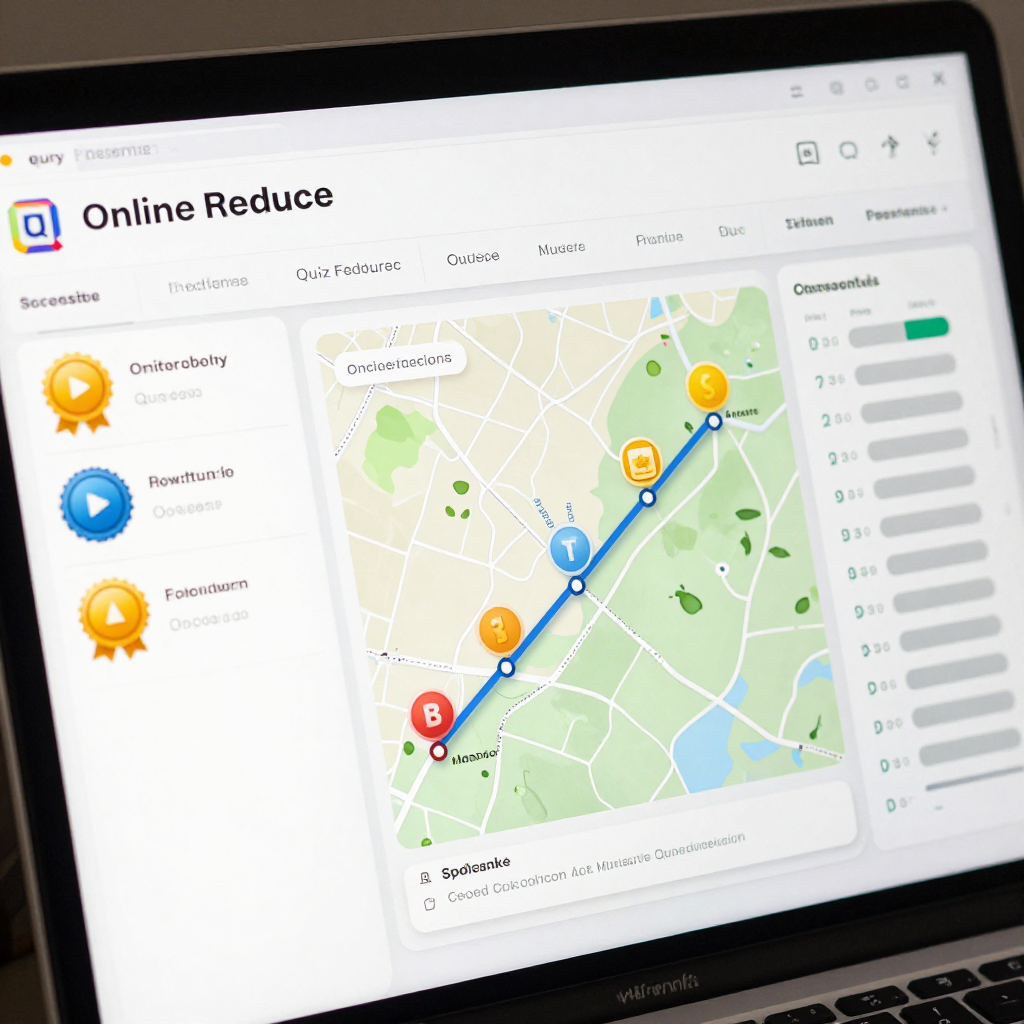
Progress indicators answer a simple question: “What have I completed, and what should I do next?” A unit checklist, milestone map, or weekly learning streak can reduce uncertainty. Avoid misleading indicators that count only page views when the real goal is mastery.
How to Use Gamification in an Online School
An online school can use gamification by attaching simple mechanics to lessons, assessments, discussions, practice tasks, and course completion. Start with one learning problem, such as low quiz participation, instead of adding game features everywhere.
Lessons and assessments
After a video lesson on financial literacy, learners might complete a three-question budget challenge. They receive points for attempting each question and targeted feedback for every response. A second attempt can earn recognition for improvement, so the system values learning rather than first-try performance.
Discussion activities
Discussion boards can use contribution badges for asking a thoughtful question, referencing course material, or giving constructive peer feedback. A rubric should define quality clearly. Awarding points for posting frequently can produce shallow comments and increase moderation work.
Practice tasks
Language learners could unlock conversation scenarios after completing vocabulary practice. In a coding course, a debugging challenge could reveal progressively specific hints. Learners should be allowed to retry, review explanations, and choose a suitable difficulty level.
Course completion
Milestones can guide learners through orientation, core lessons, applied practice, and final reflection. A completion certificate may recognize the full journey, while smaller achievements help learners see progress before the end. Make requirements transparent so students know how achievements are earned.
Instructors should also review the learner experience on mobile devices, with screen readers, and under low-bandwidth conditions. A visually impressive reward system that is difficult to navigate creates friction rather than engagement.
Designing Gamified Learning That Supports Real Learning
Gamified learning supports real learning when every game mechanic is connected to an observable objective, an appropriate level of challenge, and useful feedback. The design should make the desired learning behavior easier to notice and repeat.
Use this alignment test before adding a feature:
- What should the learner know or be able to do?
- Which activity lets the learner practice that outcome?
- Which mechanic encourages the activity without distorting it?
- What feedback helps the learner improve?
- How will the school measure mastery?
Difficulty needs careful calibration. If every task is trivial, points become decoration. If challenges are too hard and feedback is vague, learners may disengage. A useful progression begins with guided practice, moves to independent application, and ends with a realistic problem or performance task.
Accessibility and learner choice belong in the design from the start. Provide text alternatives for visual badges, keyboard-friendly controls, captions, readable color contrast, and non-timed options where timing is not part of the objective. Let learners opt out of public leaderboards while retaining access to personal progress data.
Balance external rewards with intrinsic motivation. Recognition can open the door, but relevance, competence, autonomy, and useful feedback keep learners moving. A certificate may attract attention; a well-designed challenge that solves a real problem gives the course lasting value.
Benefits and Potential Challenges of Gamified E-Learning
The benefits of gamified e-learning include stronger participation, more frequent practice, clearer progress, and faster feedback. The challenges include distraction, unhealthy competition, unequal access, and dependence on external rewards.
Potential benefits
- Breaks long courses into achievable milestones.
- Encourages active recall and repeated practice.
- Makes feedback more immediate and visible.
- Helps instructors identify incomplete or difficult activities.
- Creates opportunities for collaboration and peer recognition.
Common challenges and corrections
Rewarding speed instead of understanding: Learners may rush through quizzes to gain points. Award points for thoughtful attempts, improvement, and mastery, and avoid making speed the dominant metric.
Using competition as the default: Public rankings can motivate some students and alienate others. Offer personal goals, team formats, or private progress tracking.
Adding mechanics without instructional value: Decorative badges and animations consume design time without improving learning outcomes. Remove any feature that does not support practice, feedback, persistence, or reflection.
Ignoring accessibility and learner differences: A single reward structure will not suit everyone. Provide multiple ways to participate and test the course with learners who use different devices and assistive technologies.
The trade-off is straightforward: choosing more visible game mechanics for immediate excitement means accepting a greater risk of distraction. A quieter progress system may feel less flashy but can support sustained learning more reliably.
A Practical Framework for Adding Gamification to a Course
A practical gamification framework follows five steps: define outcomes, select mechanics, create activities, test the experience, and evaluate learner progress. This sequence keeps course design focused on education rather than decoration.
- Define the learning outcomes. Write measurable outcomes such as “compare two research sources” or “solve a linear equation,” rather than “understand research.”
- Select the smallest useful mechanic. Choose a quiz, milestone, progress bar, badge, challenge, or feedback loop that directly supports the outcome.
- Create the activity and feedback. Include realistic prompts, retry opportunities, explanations, and a clear connection to the next lesson.
- Test the learner experience. Ask a small group to complete the activity on desktop and mobile. Check instructions, timing, accessibility, scoring, and emotional response.
- Evaluate and refine. Review completion patterns, quiz attempts, quality of submissions, learner comments, and assessment results. Keep what supports learning; revise or remove the rest.
A useful final checklist for an online school is: Objective, Activity, Feedback, Choice, Evidence. If a gamification feature has no clear objective, no meaningful activity, no helpful feedback, no learner choice, or no evidence of progress, it probably needs redesigning.
Frequently Asked Questions About Gamification in E-Learning
What is gamification in e-learning?
Gamification in e-learning uses game-inspired features, including points, badges, challenges, levels, and progress tracking, to support participation and practice in an educational course.
How does gamification improve learner engagement?
It can improve learner engagement by making goals visible, breaking work into manageable steps, providing immediate feedback, and giving learners more opportunities to interact with course content.
What are examples of gamification in online courses?
Examples include scenario-based challenges, low-stakes quizzes, milestone badges, progress bars, personal achievement goals, peer-feedback points, and certificates for completing a learning pathway.
Is gamification suitable for every type of learner?
No single approach suits every learner. Offer choices, accessible alternatives, private progress tracking, and noncompetitive pathways so students can engage without pressure or unnecessary barriers.
How can an online school use gamification effectively?
An online school can use gamification effectively by linking each mechanic to a learning outcome, testing activities with real learners, rewarding meaningful progress, and evaluating learning evidence rather than clicks or points alone.