

The Future of Online Education: Key Trends and Predictions for 2025–2030
Why Online Education Is at a Turning Point
Online education has moved well past its experimental phase. What started as a convenient alternative to campus-based study has become a primary pathway for millions of learners worldwide — and the next five years will determine whether it becomes the dominant model of education altogether.
The COVID-19 pandemic accelerated adoption by roughly a decade. Institutions that once resisted digital transformation were forced to adapt overnight. Now, with that infrastructure in place, the real innovation is beginning. Learning Management Systems have matured, internet access continues to expand globally, and learner expectations have shifted permanently toward flexibility and relevance.
Between 2025 and 2030, several forces will converge: artificial intelligence reaching practical maturity in educational applications, a labor market demanding continuous reskilling, and a generation of learners who treat education as an ongoing practice rather than a one-time credential. The question is no longer whether online learning works — it's how far it can go.
AI-Powered Personalization Will Redefine How We Learn
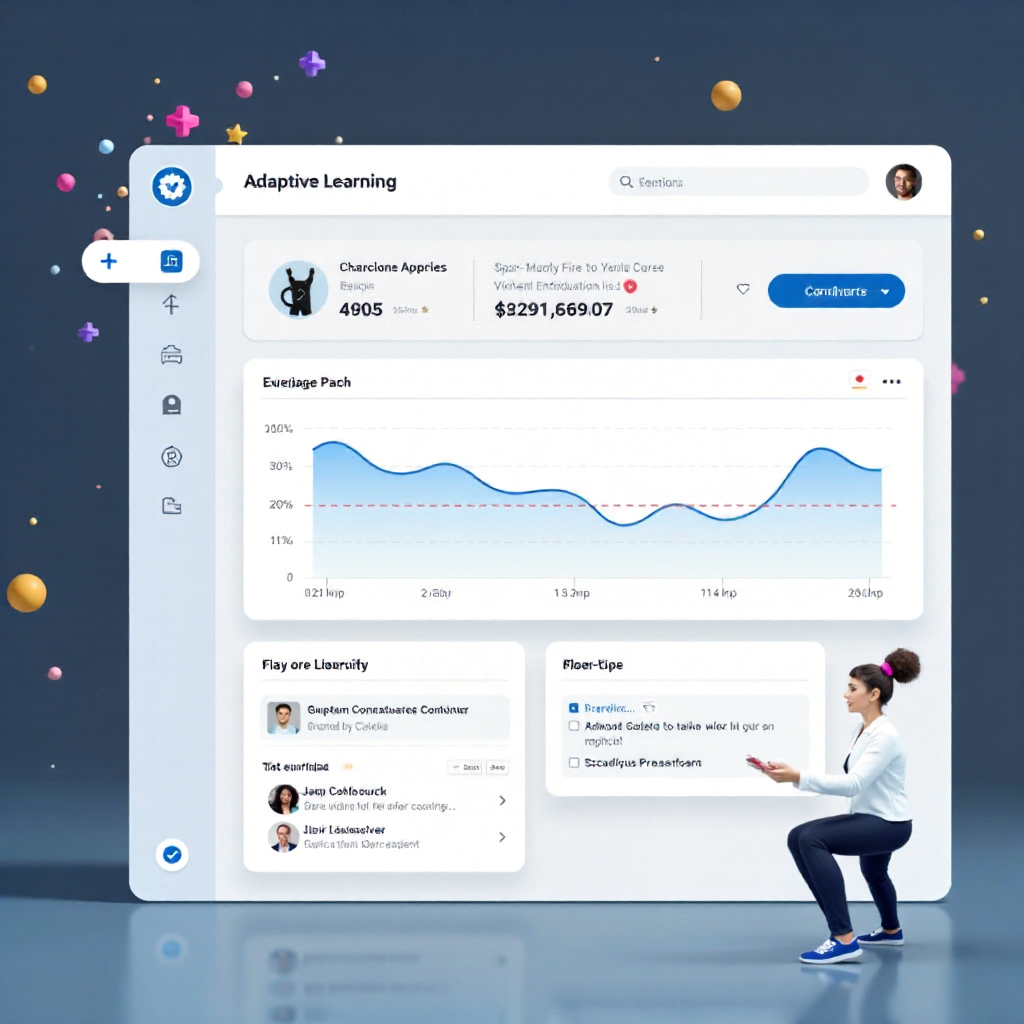
Artificial intelligence in education is shifting from a back-office tool to the engine driving the entire learning experience. By 2027, most serious online platforms will use AI not just to recommend courses, but to dynamically adjust the pace, sequencing, and difficulty of content based on how each learner actually performs.
Think of it this way: traditional online courses offer the same video to every learner regardless of what they already know. AI-driven adaptive assessments change that. A learner who breezes through foundational concepts gets accelerated to more complex material; someone who struggles receives additional examples, alternative explanations, or a brief review module — all without waiting for an instructor to notice.
This isn't speculative. Platforms like Duolingo have already demonstrated that adaptive algorithms improve completion rates and retention. The next generation of tools will apply this logic across professional certifications, degree programs, and corporate training.
The honest trade-off: AI personalization works best when learners engage consistently. Sporadic participation produces thin data, which leads to less accurate adaptation. The technology amplifies effort — it doesn't replace it.
Micro-Credentials and Stackable Qualifications Are Gaining Ground
The shift toward digital credentials and micro-credentials reflects a practical reality: employers increasingly care about what you can do, not just what degree you hold. Modular, verifiable badges and certificates that demonstrate specific skills are gaining traction across industries from technology to healthcare.
Stackable qualifications — where individual certificates combine into larger recognized qualifications — give learners a flexible path. Someone can earn a data analysis badge, add a machine learning certificate six months later, and eventually stack those into a recognized professional qualification, all while working full-time. This model fits the reality of adult learners who can't step away from careers for two or four years.
Major employers including Google, IBM, and many Fortune 500 companies have already dropped four-year degree requirements for certain roles, replacing them with demonstrated competency. By 2030, this trend will likely accelerate, especially as blockchain-verified credentials make it easier to authenticate qualifications without institutional intermediaries.
One genuine challenge remains: not all micro-credentials carry equal weight. A badge from a respected institution or industry body means something; one from an unknown platform may not. Learners need to evaluate the issuing organization's reputation just as carefully as the course content itself.
Immersive Technologies Will Make Online Learning More Experiential
Immersive learning through VR and AR is beginning to close the gap between watching a screen and actually doing something. This matters most in fields where hands-on practice is non-negotiable — surgical training, architectural design, equipment maintenance, and emergency response.
A medical student using a VR simulation can practice a procedure dozens of times before entering a clinical setting. An engineering learner can disassemble a virtual turbine, make errors, and observe consequences without any physical risk or material cost. These aren't futuristic concepts — they're already deployed in select programs, and costs are dropping fast.
By 2028, expect VR/AR tools to appear in mainstream professional training programs, not just elite institutions. The barrier has been hardware cost and content development time. Both are declining as platforms like Meta and Apple push spatial computing into broader consumer markets.
That said, immersive technology won't replace text-based and video learning for most subjects. Reading, writing, and analytical thinking don't require a headset. The real value of immersive tools is narrow but deep — transformative for specific skill types, irrelevant for others.
The Rise of Lifelong and On-Demand Learning
The cultural shift toward lifelong learning is arguably the most significant structural change in education over the next decade. The idea that education ends at 22 is already obsolete for many professionals — by 2030, continuous upskilling will be a baseline career expectation, not a differentiator.
Automation and AI are reshaping job roles faster than traditional degree programs can respond. A software developer who learned their stack in 2020 may need to relearn significant portions of their workflow by 2027. An accountant whose firm adopts AI-assisted auditing tools will need to understand how to supervise and interpret those systems, not just operate legacy software.
Asynchronous learning — self-paced, available on demand — is perfectly suited to this reality. Adults with careers, families, and irregular schedules can't commit to fixed class times. Online platforms that offer modular content consumable in 15-30 minute sessions (microlearning) fit naturally into commutes, lunch breaks, and evenings.
The platforms that will win this space are those that make re-entry frictionless. Returning to learning after a two-year gap should feel like opening a familiar app, not enrolling in a new institution.
Challenges Online Education Must Overcome by 2030
Online education's potential is real, but so are its structural problems. Three challenges in particular will shape whether the industry fulfills its promise or fragments into a two-tier system.
Learner engagement and retention remain the industry's most stubborn metrics. Completion rates for open online courses have historically hovered between 5-15%. Cohort-based models, social learning features, and accountability structures help — but the fundamental challenge of sustaining motivation over weeks or months in a fully asynchronous environment hasn't been solved.
Global accessibility is improving but uneven. Broadband infrastructure, device availability, and language barriers still exclude significant portions of the global population from quality digital education. A learner in rural Southeast Asia or sub-Saharan Africa faces a fundamentally different access reality than one in Western Europe. Offline-capable content, mobile-first design, and multilingual platforms are partial solutions, but the gap remains wide.
Credential recognition is the third major hurdle. Many employers and academic institutions still apply inconsistent standards when evaluating online qualifications. This will shift gradually as more respected universities offer fully online degrees and as employer hiring data accumulates — but the transition will be uneven across industries and geographies through the end of the decade.
What This Means for Students Choosing Online Schools Today
If you're evaluating online learning options now, the trends above offer a practical filter. Choose platforms and programs that are building toward the future, not just digitizing the past.
- Look for adaptive learning features. Platforms investing in AI-driven personalization will deliver better outcomes as the technology matures. Static video libraries with no feedback loop are already a step behind.
- Prioritize recognized credentials. Before enrolling, research whether the certificate or qualification is valued by employers in your target field. Industry partnerships and employer endorsements are meaningful signals.
- Choose modular programs where possible. Stackable qualifications give you flexibility — you can pause, return, and build incrementally without losing progress.
- Assess engagement infrastructure. Does the platform offer peer interaction, mentorship, or cohort learning? These features correlate strongly with completion and satisfaction.
- Think in terms of skills, not just subjects. The most durable online learning investments build demonstrable, specific competencies — not just general knowledge.
The learners who will benefit most from the next wave of online education are those who approach it actively: setting clear goals, engaging with the community, and treating digital credentials as genuine professional assets. The infrastructure is improving rapidly. What you bring to it still determines what you get out.
Frequently Asked Questions
Will online degrees be as respected as traditional degrees by 2030?
Respect for online degrees is growing steadily, particularly from accredited universities. By 2030, the distinction between "online" and "on-campus" will matter less than the reputation of the institution and the relevance of the qualification. Employers in technology, business, and healthcare are already shifting focus toward demonstrated skills over delivery format.
How will AI change the role of teachers and instructors in online schools?
AI will handle routine tasks — grading objective assessments, tracking progress, flagging at-risk learners — freeing instructors to focus on mentorship, complex feedback, and course design. The instructor role shifts from information deliverer to learning architect and coach. Human connection and expert judgment remain irreplaceable, especially for nuanced or creative subjects.
What types of online courses will be most in demand between 2025 and 2030?
Technology skills (AI, data analysis, cybersecurity), healthcare and wellness, business and entrepreneurship, and creative fields like UX design and content creation are expected to see strong demand. Courses that combine practical, job-relevant skills with recognized credentials will consistently outperform purely theoretical programs.
Is online education suitable for all age groups and learning styles?
Online education works across age groups, but the format matters. Young learners often benefit from more structured, interactive environments with instructor presence. Adult learners tend to thrive in asynchronous, self-paced models. Platforms are increasingly offering multiple learning modalities — video, text, audio, interactive exercises — to accommodate different preferences within a single course.
How can learners stay motivated and engaged in a fully online environment?
The most effective strategies are structural: set a fixed weekly study schedule, join cohort or community features on the platform, set short-term milestones rather than focusing on the full course length, and connect your learning to a specific professional goal. Accountability partners — even informal ones — significantly improve completion rates for self-paced programs.